Understanding Silybum marianum (Milk Thistle) and Silymarin: Why the “High” Dose Suggestions, What They Mean, and What to Watch
by Chelsea Kent
Introduction
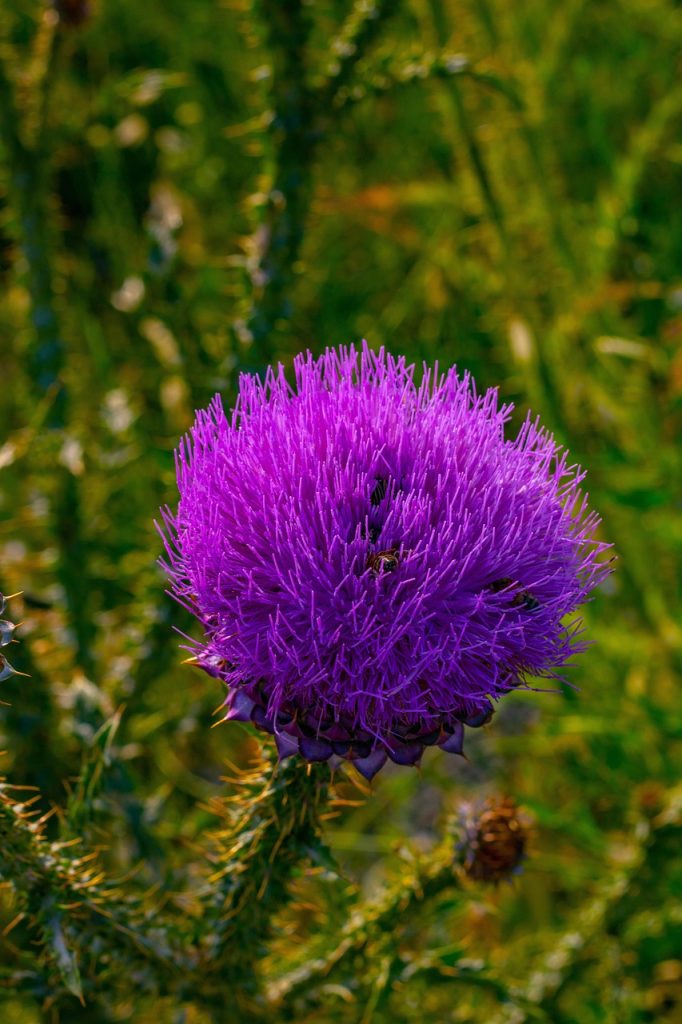
Milk thistle (Silybum marianum) has been used for centuries for liver and gallbladder support in humans, and more recently in companion animals. The active extract known as silymarin (a complex of flavonolignans) is often recommended at surprisingly high doses — higher than one would ever achieve by simply feeding whole milk-thistle seed.
Part 1: Silymarin Content in Whole Organic Milk Thistle Seeds
When you look at the seed of Silybum marianum in its “whole herb/seed” form (ground or raw), the actual silymarin content is modest. Based on agronomic and phytochemical data:
-
- Whole milk thistle seeds typically contain ≈4–6% silymarin complex by weight (this varies by growing conditions, harvest timing, seed quality, storage and processing).
- For example: if you had 100 g of whole milk-thistle seed, you’d be getting ~4–6 g of silymarin on average.
- The “silymarin complex” is made up primarily of flavonolignans: silybin A & B (the most widely studied), as well as isosilybin, silydianin, silychristin, etc.
So, when someone feeds or recommends “milk thistle seed” or a whole herb form, the actual active dose of silymarin is relatively small compared to what many extract-products deliver.
Part 2: Why “70% Silymarin” (or 70-80%) Is Common in Extracts (But Not Natural)
If you browse commercial milk-thistle supplements, you’ll often see labels like “standardized to 70% silymarin” (or 70–80%). Why is that?
-
- The natural content of the seed is ~4–6% (see above), so 70% is far above the whole-herb baseline.
- The high number comes from alcohol extraction and concentration (e.g., ethanol or methanol extraction), often followed by binding agents (like phosphatidylcholine in “phytosome” formulations) and adjustments of heat/pHto maximize yield (see Radko et al., 2003).
- The rationale for it:
- Most clinical pharmacological research uses standardized 70–80% silymarin extracts (especially for liver disease in humans).
- Extracts allow for precise dosing, which appeals to practitioners and regulators.
- The “perceived potency” is higher — the assumption is that more silymarin = more effect.
However, there’s also an economic motivation rarely discussed in scientific literature. It’s far more profitable for manufacturers to sell concentrated isolates than inexpensive, minimally processed herbs. Creating an extract allows patentable formulations, exclusive branding, and “pharmaceutical-grade” marketing — whereas selling whole seeds offers little margin or proprietary control.
As a result, most of the research supporting high-dose silymarin comes from or through companies that produce those isolates, often with financial or methodological bias. Studies frequently:
-
- Use short-term endpoints (e.g., temporary liver enzyme normalization) rather than long-term health outcomes.
- Compare high-dose isolates to placebo rather than to whole-seed preparations.
- Omit data on nutrient loss, metabolic burden, or phase I/phase II detox balance that may shift unfavorably with isolates.
- Fail to address individual sensitivity or cumulative exposure risks in chronic users or smaller animals.
Even though most trials conclude that high-concentration silymarin is “safe,” longer-term or higher-dose use has raised concerns, including:
-
- Gastrointestinal upset (nausea, bloating, diarrhea) in both humans and dogs.
- Detox overload from overstimulating hepatic phase I enzymes without matching phase II support.
- Altered drug metabolism via CYP enzyme modulation, potentially lowering or increasing the effects of medications processed by the liver.
- Hormone-related effects, since silymarin can influence estrogen receptors.
- Allergic reactions, particularly in individuals or animals sensitive to ragweed, daisies, marigolds, or other Asteraceae plants, since milk thistle belongs to that same botanical family.
Thus, the high doses you see in veterinary or human literature are largely tied to standardized, profit-driven extract products rather than to traditional, food-like whole-seed forms — and the science surrounding them often overlooks the nuanced, long-term physiological implications that nature avoids through balance.
Part 3: Why Nature Provides Less Silymarin
Why does the natural seed only supply ~4–6% silymarin? This isn’t a “defect” — nature’s design is different. Here are some considerations:
-
- Balanced phytochemistry: The seed contains not only the flavonolignans but also essential fatty acids, proteins, bitter compounds, antioxidants, fiber, and mucilage. These components together support detoxification, liver health and digestion in a more “holistic” way.
- Self-regulation of potency: Very high concentrations of isolates may overwhelm metabolic pathways in animals or humans; nature often supplies lower-level exposures that are gentler.
- Whole-body compatibility: A whole herb/seed requires digestion and metabolic transformation, so its active compounds are gradually released and processed rather than flooding the system.
- This is analogous to other herbs: for example, willow bark provides low salicin (versus synthetic aspirin), turmeric whole-root offers curcuminoids in a matrix (versus isolated curcumin) — the matrix often moderates absorption and effect, reducing risk of overdose or side-effect.
Hence, one can view whole seed as a gentler “tonic” whereas extract is more “therapeutic”.
Part 4: Potential Drawbacks of High-Isolate Silymarin Extracts
While 70-80% silymarin extract formulas have a place in therapeutic settings, they come with trade-offs:
Loss of whole-seed components
-
- When you concentrate the flavonolignans you remove or diminish many of the seed’s “co-factors” (vitamin E, sterols, linoleic acid, mucilage, fiber etc) that support cell-membrane integrity, gut health, bile regulation.
- Hence the synergy provided by the whole seed may be lost.
Overload or narrow action
-
- High isolate doses may overstimulate Phase I detoxification pathways without supporting Phase II adequately (which may increase intermediate reactive metabolites).
- In sensitive animals/people this can lead to “detox symptoms” (nausea, headaches, skin eruptions), especially if bile flow or gallbladder function is sluggish.
- Also, isolates may accelerate metabolism of co-administered medications (via CYP/UGT systems) — see Radko et al. 2003.
Diminished adaptogenic/holistic effect
-
- Whole-seed forms provide a broader range of phytochemicals that may act as mild adaptogens (stress protective, antioxidant) rather than just “fire-hose” organ-specific support.
- For chronic or sensitive patients/pets, the gentler broader support may be preferable.
Safety/monitoring concerns
-
- Although generally well-tolerated, high doses of extract may carry higher risk of side effects (see toxicity data). Radko et al report LD50 values in animals being very high, but that does not assure absence of long-term subclinical effects.
- In veterinary use, the wide variation of formulations and lack of large‐scale controlled studies means you should monitor carefully.
Here’s a quick comparison table:
| Form | Approximate silymarin % | Pros | Cons |
| Whole Seed (raw or ground) | ~4-6% | Gentle, synergistic, whole-food matrix | Lower potency, slower action |
| Standardized Extract (70-80%) | 70-80% | Clinically studied, potent | Lacks seed synergy, higher side-effect risk |
|
Phytosome (e.g. silybin-phosphatidylcholine)
|
~30-40% (bound form) | Enhanced bioavailability | Expensive, even further from whole food matrix |
Part 5: Is the high dosing justified?
-
- In therapeutic scenarios (acute hepatotoxin exposure, liver disease, chemotherapy adjunct) yes — there is justification for higher doses of extract forms.
- In maintenance/supportive scenarios (healthy dog, mild liver strain) probably not; a lower dose (or whole seed form) can suffice and may carry lower risk of overload or side-effects.
- Always check formulation (seed vs extract, % standardization, bioavailability) and tailor to the clinical context.
Part 6: Allergy Risk & Asteraceae / Ragweed Cross-Reactivity
Milk Thistle belongs to the Asteraceae (Compositae) plant family (same family as ragweed, daisies, marigolds). Here’s what the literature shows:
-
- The human health data (e.g., Mayo Clinic) says: “An allergic reaction is more common in people who are allergic to other plants in the Asteraceae family, such as ragweed, daisies, marigolds and chrysanthemums.”
- A 2024 article on IgE-mediated allergy to Asteraceae plants concluded: “Milk thistle may prompt an allergic reaction in patients with hypersensitivity to member plants such as ragweed, marigolds…”
- A case report (Gil-Serrano et al 2025) noted the first documented anaphylactic reaction to milk thistle seed, identifying candidate seed proteins (14 and 17 kDa) and raised the possibility of cross-reactivity within the Asteraceae family (e.g., ragweed, mugwort) though no other cases had been reported previously. Taking breaks from Milk Thistle / Silymarin supplementation and rotating with Solutions Immune, Solutions Restore, and Solutions BIOME for liver support is an ideal way to continually support the liver while also taking breaks from each individual herb.
- Additionally, cross-reactivity lists show that milk thistle appears on a “ragweed cross-reactive food/herb” list.
Implications for pets/owners
-
- While specific documented allergy cases in dogs to milk thistle are scarce, the botanical family and documented cross-reactivity in humans suggest a theoretical risk.
- If an owner or pet has a known allergy to ragweed, daisies, chamomile, or other Asteraceae plants, caution is warranted before dosing significant milk-thistle extracts.
- Even more so when using high-concentration extracts (since allergenic proteins may be more concentrated in seed-derived/processed products).
- Practically: screen for environmental/plant allergies; monitor for signs of allergy (itching, GI upset, respiratory signs, hives) especially when starting or increasing dose.
Conclusion
In summary: the often-quoted “high” dosing of silymarin (especially in dogs) is rooted in the use of purified, standardized extracts rather than whole seeds, and in the desire to provide measurable therapeutic effect in hepatic disease rather than just baseline support. The natural seed supplies ~4-6% silymarin, whereas extracts frequently deliver 70-80% and thus require far smaller amounts of product (but may carry higher risk of side-effect or narrower benefit).
Whole-seed forms have value for gentler, broader support, while extracts have their place for targeted therapy. The key is to tailor formulation, dose, and monitoring to the individual patient and the condition.
Finally, don’t overlook allergy risk — milk thistle belongs to the Asteraceae family, and cross-reactivity with ragweed/mugwort/daisies is documented (albeit rare) in humans; given pets may have analogous sensitivities, proceed with caution and monitoring. Make sure you rotate through products to avoid the development of allergies to any single herb.